|
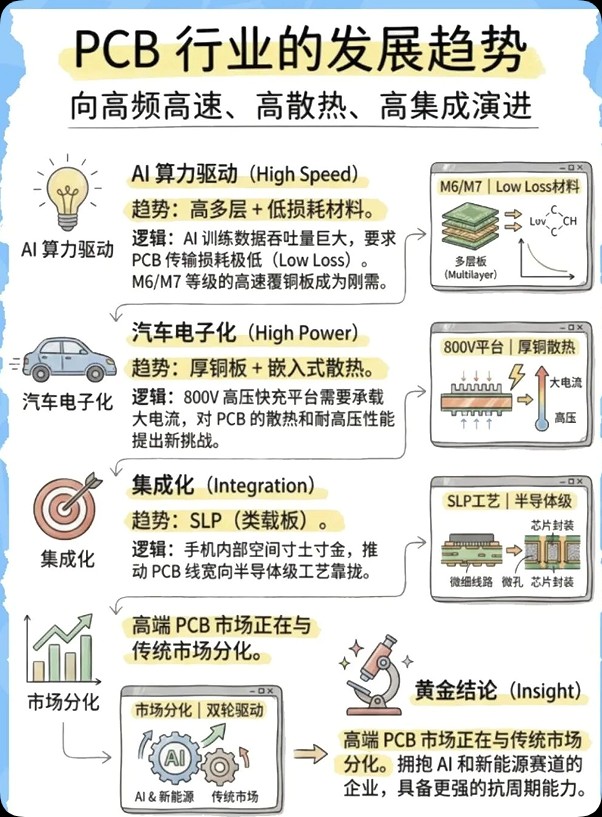
When people talk about high-speed board material selection, you often hear things like: "M4 is enough for this board," "that backplane needs at least M6," "should we use M7 for 112G PAM4?" — and some projects even ask upfront if M8 is possible. So what exactly do these "M" grades mean? Are they material grades? IPC standards? Or just terminology coined by PCB manufacturers? 1. Origin of the "M" Grades In the hardware world, M4, M6, M7 — most of the time — come from Panasonic's MEGTRON series. For example, MEGTRON 4 is commonly shortened to M4, MEGTRON 6 to M6, and MEGTRON 7 to M7. Over time, "M" grades have gradually become an informal way to describe high-speed, low-loss material grades. Other manufacturers like ITEQ and Taiwan Union also have similar product classifications. Today, when someone says "use M6 material," they may not necessarily mean Panasonic's original material — they often mean "use a material with loss characteristics equivalent to M6 grade." 2. What's the Real Difference Between M Grades? The main difference between M grades lies in high-speed loss performance. Key parameters include: Dk (Dielectric Constant): Affects impedance, trace width, and propagation speed. With the same stackup, different Dk values will change trace width and impedance results. Df (Dissipation Factor / Loss Tangent): Has a significant impact on insertion loss. The higher the data rate and the longer the trace, the more Df matters. Copper Foil Roughness: Many people focus only on Df, but copper loss is also critical at high speeds. The loss difference between standard copper, VLP (Very Low Profile), and HVLP (Hyper Very Low Profile) is substantial. Glass Weave: Standard glass, low-Dk glass, and spread glass affect Dk uniformity and the glass weave effect. This cannot be ignored for long differential pairs at high data rates. Reliability Parameters (Tg, Td, CTE, T288): These mainly relate to high-layer count boards, lead-free reflow, thermal reliability, and manufacturing stability. So an "M grade" is not a single parameter — it's the combined result of an entire material system. 3. Mainstream M Grade Classification M4: Entry-level to mid-range low-loss material. Better loss performance than standard FR-4 at a relatively acceptable cost. Commonly considered for 10G Ethernet, some PCIe Gen3/Gen4, USB3.x, and mid-to-high-speed industrial control and communication boards. M6: A very common high-speed material grade. Frequently seen in 25G, 28G, 56G PAM4, PCIe Gen4/Gen5, servers, switches, and optical modules. Its dielectric loss is significantly lower than standard FR-4 and M4, making it the go-to choice for many high-speed projects. M7: One step higher, targeting more demanding loss budget scenarios — such as 112G PAM4, 400G/800G switching equipment, high-speed backplanes, high-end servers, and AI accelerator cards. In these designs, the link budget is tight — connectors, vias, traces, copper foil, and materials all matter. M8/M9: These are for high-end and cutting-edge applications — not something casually used in ordinary projects. Think next-generation switching, 224G channels, and long backplane links. Material selection at this level requires SI simulation, PCB manufacturer capability, connector models, via optimization, and testing verification — no guesswork allowed. *Note: Standard FR-4 can still work for high-speed designs in many short-link, high-margin scenarios. Good engineering balances performance with cost.* 4. How to Choose the Right M Grade Start by examining the link. For MCU-based systems, basic power supplies, low-speed control boards, relay boards, or small sensor boards — standard FR-4 is sufficient. For USB3.0, Gigabit/2.5G Ethernet, short-reach PCIe, or short-reach high-speed ADC/DAC interfaces — consider trace length, layer count, and loss budget. Short traces with high margin may pass with FR-4. Long traces with many connectors and vias? Consider M4 or an equivalent low-loss material. For 25G, 28G, 56G PAM4, or PCIe Gen5 designs — M6 grade is common, especially when channels are long, layer counts are high, or there are many connectors. For 112G PAM4, 800G switches, or high-speed backplanes — M7 or higher is safer. Stackup, vias, connectors, copper foil, trace length, reference planes, return paths, and manufacturing consistency all require simulation and thorough evaluation. 5. Cost Differences A rough cost order: Standard FR-4 < High-Tg FR-4 < M4 < M6 < M7 < M8/M9 Higher grades mean higher material costs, stricter manufacturing requirements, fewer available PCB suppliers, and potentially longer lead times. High-end materials often come with HVLP copper, low-Dk glass, tighter impedance control, higher layer counts, and more complex lamination — all reflected in the final board price. Higher grade isn't always better — "good enough" is best.
|






 初始原理图传递